

The American Revolutionary War was the first major historical event in American History. Everything that had transpired after the first successful colony at Jamestown led to the eventual independence of America. Most of the colonies were founded by those seeking religious freedom, economic opportunity, and fleeing persecution.
The British colonies were made up of English, Irish, Scots, Welsh, German, Swedes, Dutch, French, and many other nationalities. Religions represented and living peacefully among each other were the Catholics, Protestants, Quakers, Agnostics, and Deists.
Click Here If You Want To Know If You Want To Know If You Have A Revolutionary War Ancestor.
Age of Exploration
The American Revolution did not begin with Jamestown or the Stamp Act of the Declaration of Independence, but rather when Christopher Columbus discovered a new continent.
The Reformation and the Renaissance spread across Europe and with it a new mindset. Martin Luther directly questioned the power of the Pope and condemned many of their actions while Michelangelo and Leonardo Da Vinci were inspiring many with their inventions and breathtaking art.
A new time was dawning and a different way of thinking was beginning to shape the way men processed information.
Prior to 1492, the Portuguese had begun building a new trade route to India. Henry the Navigator had begun sponsoring trips around Africa.
His efforts laid the groundwork for those that came after him. Bartolomeu Dias navigated to the tip of Africa and a few years later (after 1492) Vasco da Gama circled the Cape of Good Hope and made it to India.
Portugal would go on to create the first global trade empire. Although a small country they had carved a niche for themselves and cultivated it.
In 1492, the master navigator Christopher Columbus believed he could reach India by sailing west. Spain sponsored his voyage and Columbus set sail. That trip would lead to civilizations colliding.
Columbus died believing he had found India, but Amerigo Vespucci thought otherwise. He believed that Columbus had discovered a new continent.
Soon there would be many Spanish Conquistadors that began navigating the Caribbean and interacting with different cultures and eventually conquering whole civilizations.
Men like Juan Ponce de Leon, Vasco de Nunez Balboa, Ferdinand Magellan, Francisco Coronado, Hernan Cortes, and Francisco Pizarro began carving out their own legacies in the New World. Soon, civilizations like the Aztecs and Incas were destroyed and Spanish disease destroyed much of the native population.
These events loosened the grip of the Native Americans in the New World and set the stage for what would come next.
The French focused on colonizing Canada. Jacques Cartier and Samuel de Champlain were the first of many French explorers that began exploring and colonizing the New World. Soon, the French founded New France and had begun setting up trading posts to capitalize on the new natural resources.
The French, unlike the Spanish and eventually the English established decent relationships with the natives. They did not conquer any civilization and seemed to deal fairly with them. The French Colonies had been established in Canada while the Spanish had focused their efforts in the Caribbean.
The Dutch Republic had also founded its own colony, New Amsterdam. New Amsterdam was different from the rest of the colonies in that they did not necessarily care about an individual's religion. New Amsterdam was founded as an economic haven for merchants. It became a successful colony and one of the wealthier ports in the New World. However, the Dutch Republic was a small nation and had trouble protecting itself from the much stronger nations of Europe.
The English had been inactive due to civil war and Henry VIII's multiple divorces, but during the reign of Queen Elizabeth, they emerged as a world power and began pursuing colonization. Under the reign of King James, the English began to build permanent settlements in the New World. In 1605, Jamestown would be the first colony to be founded.
In 1620, Plymouth was founded by the Separatists. In 1627, the Puritans founded Massachusetts Bay Colony and soon afterward Pennsylvania, Connecticut, Rhode Island, and New Hampshire were settled. The English also captured New Amsterdam from the Dutch and renamed it New York City. Soon England had control of most of modern-day America's coastline and began to found colonies in the Caribbean.
Colonial America
British colonies had been established in the New World in 1605 and had been growing significantly. In 1754 the French and Indian War began and by 1756 had developed into a worldwide conflict known as the Seven Years' War. The conflict lasted until 1783 when the French surrendered to the British. In the years following the war, Britain looked for ways to pay off their war debt. In 1765 British parliament passed the Stamp Act. The Stamp Act was highly controversial and caused much division in the colonies. Men like Patrick Henry, Samuel Adams, and John Adams rose to prominence.
The mantra "No taxation without representation" was begun and the Stamp Act was repealed. Two years after the Stamp Act, Charles Townshend submitted a series of acts to Parliament known as the Townshend Acts. Once again the colonists rebelled in the form of the Boston Massacre and the Townshend Acts were repealed. After the Boston Tea Party, the British passed a series of acts known as the Intolerable Acts.
These acts would push the colonists further into rebellion and create the Continental Congress. With the formation of the Continental Congress, the colonies continued their political American Revolution with radical ideas that resulted in the writing of the Declaration of Independence and signing of the Declaration of Independence.
Declaration of Independence
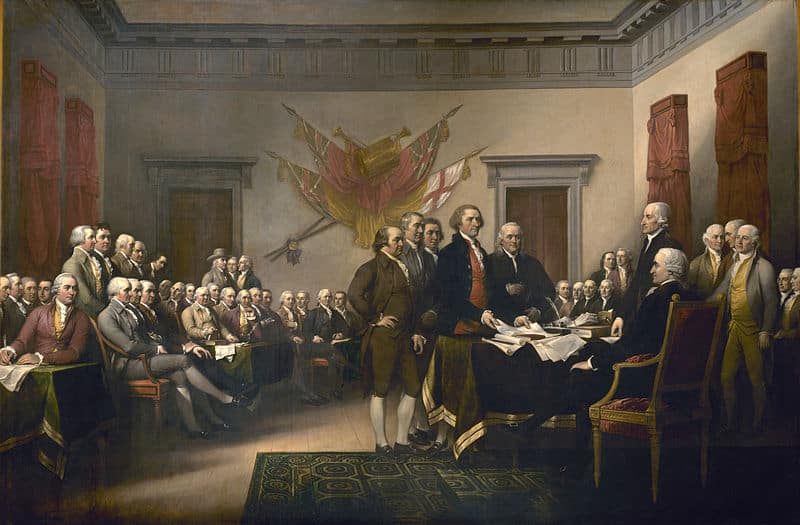
The Declaration of Independence has been romanticized since it was signed in 1776. Contrary to what many believe the document was not signed and agreed upon like some of the paintings suggest. The delegates of the Continental Congress did not meet in one room and peacefully agree to declare independence from Britain. It was a process that began in 1775 with the First Continental Congress. During the initial battles of the Revolutionary War, some of the delegates considered cutting off Massachusetts.
Initially, the reluctance to declare independence came from the Southern Colonies and some of the Middle Colonies while the New England Colonies were unified and ready to seek independence. John Adams would become the voice of independence and constantly lobbied for independence from Great Britain. He was met with resistance from John Dickinson and many of the southern delegates.
The argument began to shift in favor of independence when the Olive Branch Petition was rejected by King George III and John Adams made a surprise move in nominating George Washington as Commander-in-chief of the Continental Army.
Nominating George Washington as commander of the Continental Army made practical sense it also made political sense. George Washington supported independence and Virginia was leaning towards supporting independence. Adams knew, as did others, that whatever side Virginia fell on would sway the other colonies. Hindsight shows that Virginia would have probably chosen independence even if Washington had not been selected, but in 1775 the debate was at a stalemate.
The debate for independence changed when Richard Henry Lee delivered an electric speech declaring Virginia's allegiance to the cause. Momentum shifted and every colony began to support independence. When the vote was cast all the colonies supported independence with one abstention (New York). The Declaration of Independence was signed in the summer of 1776 and then sent to Britain and read throughout the colonies.
American Revolutionary War Facts: Military Preparations
Continental Army
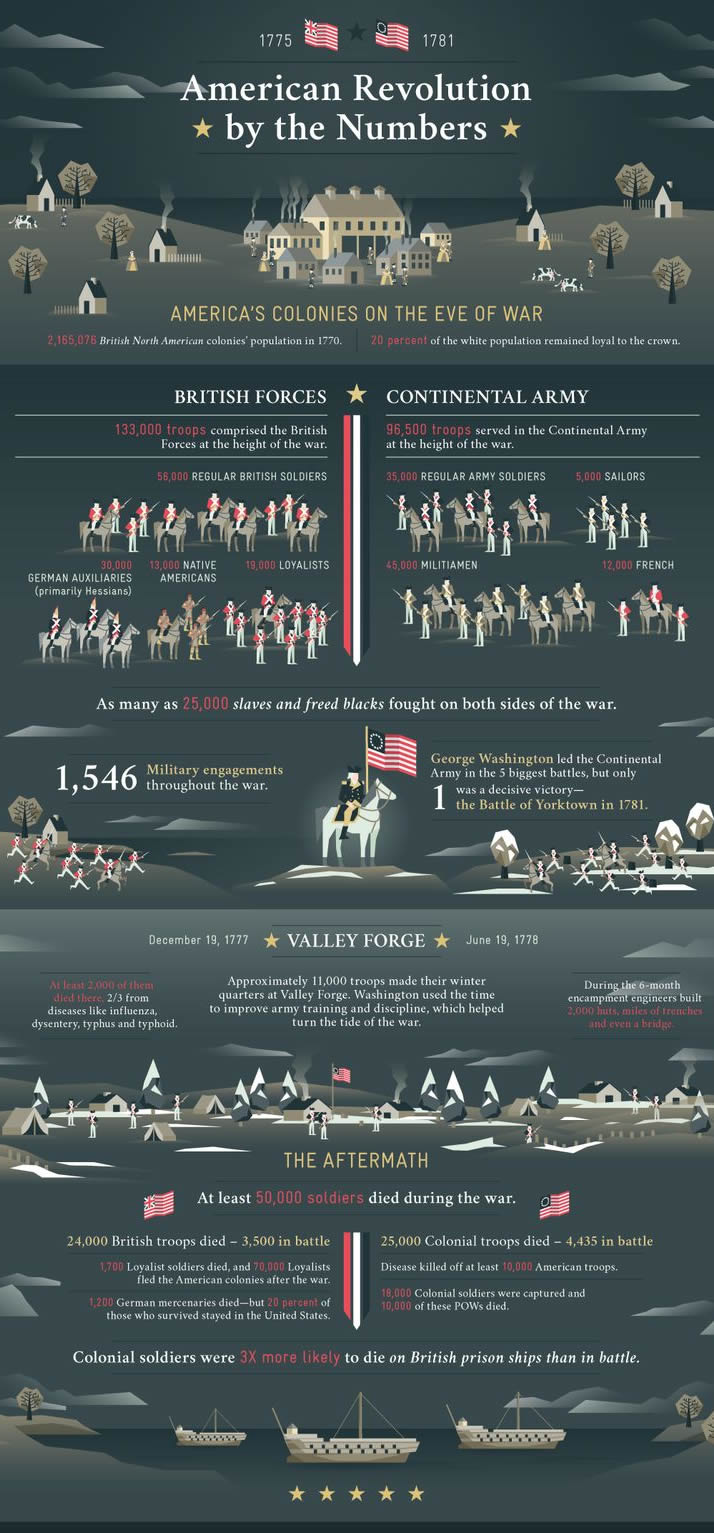
One of the common myths associated with the Continental Army was that they were inexperienced. Many of their commanders had fought in the French and Indian War and their militia was well-trained and effective at guerrilla warfare. While there are many problems with the Continental Army, courage, experience, and marksmanship were not one of them. Here are the main problems the Continental Army had during the American Revolutionary War:
- Lack of Discipline: Discipline and experience are two different things. When George Washington arrived in Boston to command the siege he quickly made infrastructure changes. Many of the men did not dispose of their bodily waste appropriately which caused disease. Washington constantly had problems with sexual relations between his men and prostitutes. Men were led by their own commanders and were not familiar with falling in line with the commander-in-chief of the entire army. These are just some of the problems that Washington faced and certainly not a comprehensive list.
- Money and Supplies: Congress paid the Continental Army with the Continental Dollar. Unfortunately, the Continental dollar was easy to forge and was exploited by the British. Due to its ease to forfeit the continental dollar fell victim to inflation which meant that the army was being paid with worthless dollars. Much of the army was funded privately and not publicly. A lack of money also means a lack of supplies. Throughout the entire war, Washington struggled to feed his army. This caused many to starve and desert the army.
- Tactics: Most of the Continental Army was made up of militia and were not regulars. The militia had not been trained to withstand multiple volleys of musket fire and was more at home firing behind trees and delivering quick strikes. Tactics vary from each battle, but most commanders struggled with how to properly use militia. At the beginning of the war, Washington and others used militia like one would use British regulars and the results were disastrous. Militia lines often broke out of fear. Towards the end of the war, tactics had changed from traditional European warfare to guerrilla-style warfare that was used by many of the natives.
- Incompetent Leadership: Horatio Gates, Charles Lee, and Benjamin Lincoln are just a few names that Congress promoted instead of listening to Washington's recommendations and they paid the price for it. Horatio Gates was disgraced at Camden, Charles Lee betrayed his country while a prisoner, and Benjamin Lincoln were over-matched at Charleston. Promoting incompetent leadership frustrated many great leaders. Men such as John Stark, Daniel Morgan, and Nathanael Greene all became frustrated. (If Benedict Arnold had not been overlooked so many times, then perhaps he would have never betrayed his country, but he had a character flaw.)
- Lack of Navy: The British Navy was the most powerful navy in the world and the American navy did not exist. This was a serious problem and why the French alliance was so important.
The French Alliance was the most important event of the war. Without France, the colonies would have remained British subjects. The French navy played a large role in the surrender of Cornwallis at Yorktown and made the war a global affair not a civil war.
British Army
The British Army was arguably one of the best armies in the world, but rather small. During the time of Frederick the Great, he estimated that the British standing army was around 20,000 men. However, their technological advancements in Naval warfare and their geographical location made them one of the strongest armies in the world. The British empire was often supported by mercenaries, such as the Hessians and in the case of the American Revolution, Indians and Loyalists.
By the 18th century, the British had met and defeated all of their foes and become the supreme power in the world, but they were not invincible. However, they would struggle to end the war in America and ultimately be defeated. While this is not a comprehensive list it does give a general idea about why the British Army struggled in America:
- Wrong Mindset: The British fought the American Revolutionary War as if it were a European war. They captured cities and fought in open fields. It did not matter how many cities you captured as long as the army stayed intact then the war would continue. Using European tactics at Bunker Hill, Saratoga, and Cowpens obliterated armies.
- Stubbornness: In 1774 most Americans were proud to be British citizens, but by 1775 that mindset had changed. The extreme groups began to suggest independence and each of the British actions pushed their subjects in that direction. The overly aggressive acts, the use of mercenaries, and the butchery that occurred caused much support to be lost as it gave confirmation to what men like Samuel Adams had said.
- Racism: If the British would have used runaway slaves more effectively, then they would have won the war...there I said it. I believe it is that simple. The slave did not see the revolution as a positive but was indifferent. They were treated as dogs and in many cases worse than them. When the slaves were offered freedom if they served in the British army many of them fled. The British were overwhelmed with how many came and did not use many in the British Army. They could have made an entire army of slaves and established a flow of reinforcements, but men like Banastre Tarleton hindered that process.
- Arrogance: The British army believed that one or two great victories would show their might and that their subjects would obey. That did not happen. Lexington and Concord, Bunker Hill, Fort Ticonderoga, Machias, Chelsea Creek, and Dorchester Heights proved that the Continental Army could win. The British grossly underestimated the colonists and as a result, took heavy losses which lifted American morale.
- French Alliance: Americans will never understand how important the French alliance was to the American Revolution. When France entered the war the British no longer could focus exclusively on the colonies, but rather had to watch their colonies in the Caribbean Sea and in Europe. It extended its Navy which resulted in their defeat at Chesapeake and ultimately the surrender at Yorktown.
The American Revolutionary War was a debacle for the British. It did not display the competence of King George III nor the power of the British Army. It was gross mismanagement of resources and possibly could have been avoided if the British had provided representation.
American Revolutionary War Facts: Boston Campaign
On the evening of April 18, 1775, General Thomas Gage sent 700 men to seize ammunition stored by the colonial militia at Concord, Massachusetts. Riders including Paul Revere, William Dawes, Dr. Samuel Prescott, and Abel Prescott under instructions from Joseph Warren participated in the famous midnight ride, and when British troops entered Lexington on the morning of April 19, they found 77 minutemen formed upon the village green. Shots were exchanged, killing several minutemen. The British moved on to Concord, where a detachment of three companies was engaged and routed at the North Bridge by a force of 500 minutemen.
As the British retreated back to Boston, thousands of militiamen attacked them along the roads, inflicting heavy casualties before timely British reinforcements prevented a total disaster. With the Battles of Lexington and Concord, the war had begun. The militia converged on Boston, bottling up the British in the city. About 4,500 more British soldiers arrived by sea, and on June 17, 1775, British forces commanded by General William Howe overtook the Charlestown peninsula at the Battle of Bunker Hill. The provincials, under William Prescott, fell back, but British losses were so heavy that the attack was not followed up. Gage was replaced and General Howe had a new respect for the provincials.
The Siege of Boston would not be broken. The standoff continued throughout the fall and winter. In early March 1776 under new commander-in-chief George Washington, heavy cannons that the patriots had captured at Fort Ticonderoga were brought to Boston by Colonel Henry Knox and placed on Dorchester Heights. The next morning Howe woke up and stated this famous line, "My God, these fellows have done more work in one night than I could make my army do in three months." The British then removed themselves from Boston and never returned.
American Revolutionary War Facts: Quebec Campaign
Three weeks after the siege of Boston began, a troop of militia volunteers led by Ethan Allen and Benedict Arnold captured a surprised Fort Ticonderoga, which lied between New York and Quebec. The colonists also raided Fort St. John's, not far from Montreal, which alarmed the population and the authorities there. In response, Quebec's governor Guy Carleton began fortifying St. John's and began negotiating with the Iroquois and other Native American tribes for their support. These actions, combined with lobbying by both Allen and Arnold and the fear of a British attack from the north, eventually persuaded the Continental Congress to authorize an invasion of Quebec.
On September 28, 1775, Brigadier General Richard Montgomery marched north from Fort Ticonderoga with about 1,700 militiamen, besieging and capturing Fort St. John on November 2 and then Montreal on November 13. General Carleton escaped to Quebec City and began preparing that city for an attack. The second expedition, led by Colonel Arnold, went through the wilderness of what is now northern Maine. Logistics were difficult, with 300 men deserting, and another 200 perishing due to the harsh conditions.
By the time Arnold reached Quebec City in early November, he had but 600 of his original 1,100 men. Montgomery's force joined Arnold's, and they attacked Quebec City in the Battle of Quebec on December 31 but were defeated by Carleton in a battle that ended with Montgomery dead, Arnold wounded, and over 400 Americans taken prisoner, including Daniel Morgan.
The remaining Americans held on outside Quebec City until the spring of 1776, suffering from poor camp conditions and smallpox, and then withdrew when a squadron of British ships under Captain Charles Douglas arrived to relieve the siege. Another attempt was made by the Americans to push back towards Quebec, but they failed at the Battle of Trois-Rivières on June 8, 1776. Carleton then launched his own invasion and defeated Arnold at the Battle of Valcour Island in October. Arnold fell back to Fort Ticonderoga, where the invasion had begun.
While the invasion ended as a disaster for the Americans, Arnold's efforts in 1776 delayed a full-scale British counter-offensive until the Saratoga campaign of 1777. Arnold played a key role in both.
American Revolutionary War Facts: New York and New Jersey Campaign
After the British vacated Boston the morale of the Continental Army reached a new high. New recruits piled in and Congress saddled General Washington with the impossible task of defending New York without a navy. George Washington and Nathanael Greene wanted to destroy the city, but Congress would not allow him to do so. He was met with defeat in New York beginning with the largest battle fought in the war, The Battle of Long Island. Washington then pulled off one of the most impressive acts of any commander in the war when he personally organized a retreat that removed his entire army from Long Island in one night. This feat saved the war effort and is considered one of Howe's worst moments.
From there the Americans continued to meet defeat after defeat. The British drove the Americans from Harlem Heights, defeated them at the Battle of White Plains and then captured 2,000 rebels and their supplies at the masterful assault on Fort Washington. The captured rebels would soon find themselves in prison ships. With the rebels reeling and morale low Howe continued his assault. He detached Henry Clinton to seize New Haven, Rhode Island and Lord Cornwallis to pursue Washington's army through New Jersey. Cornwallis came close to capturing Washington's army, but missed the opportunity when Washington crossed the Delaware River. Frustrated with his missed opportunity Cornwallis set up winter quarters and would continue his campaign the next spring.
Shortly after this escape a young officer under named Benjamin Tallmadge organized a secret spy ring that would be called the Culper Spy Ring. These spies would become the most successful spies during the American Revolutionary War.
With the British and the Hessian mercenaries nestled in for the winter Washington planned a covert operation that would surprise the Hessians at Trenton and Princeton. On December 26, 1776 Washington made a daring attack in what is known as the Battle of Trenton and the Battle of Princeton. The assault would be successful and would raise morale enough to fight another day. After the battles Washington quickly returned to the other side of the Delaware. The militia groups would continue to harass the British and would force them to return to their base in New York.
American Revolutionary Facts: Saratoga Campaign
Saratoga was the first campaign to begin in 1777. General John Burgoyne left Quebec with 8,000 men in an effort to capture the St. Lawrence river which would effectively isolate the New England Colonies. His plan was supported by a second column of 2,000 men led by Barry St. Leger who marched them down the Mohawk River. The two would meet in Albany, New York.
The early portion of Burgoyne's campaign was met with some success. He recaptured Fort Ticonderoga in July, but was slowed when rebels cut down trees to block his way. He would lose close to 1,000 men in the Battle of Bennington. Meanwhile St. Leger ran into his own problems. After his success in the Battle of Oriskany, Benedict Arnold attacked and scattered St. Leger's indian allies and sent him back to Quebec. With the loss of St. Leger's men, the losses at the Battle of Bennington and the men needed to garrison Fort Ticonderoga, Burgoyne was down to 6,000 men.
However, he was expecting General Howe to come to his relief but Howe had other plans and instead sailed to capture Philadelphia which left Burgoyne exposed. General Horatio Gates had entrenched his army of 8,000 men at Saratoga. Burgoyne tried to outflank the Americans in the first battle of Saratoga and was repelled. With Howe chasing glory in Philadelphia Burgoyne's situation was bleak. He launched the second battle of Saratoga and was soundly defeated. The entire Northern Army was defeated. General Horatio Gates received all of the credit, although the success was largely due to Benedict Arnold and Daniel Morgan.
The victory aided Benjamin Franklin in securing an alliance with France, thus making this a world war.
American Revolutionary War Facts: Philadelphia Campaign
While General Horatio Gates was enjoying success in Saratoga, Washington was protecting Philadelphia from British invasion. Washington was met with defeat at the Battle of Brandywine. Howe would successfully outmaneuver Washington and walk into Philadelphia unopposed. Washington would launch an attack that was successfully repelled in the Battle of Germantown. He then retreated into Valley Forge where he set up winter quarters.
After Washington pushed the British back in the Battle of White Marsh he set up winter quarters at Valley Forge where a Prussian soldier by the name of Baron Von Steuben began to train the rebels. Washington wanted an army that would "look the enemy in the eye" and Von Steuben would provide that. He trained the Continental Army in the most advanced Prussian techniques. This training would prove to be successful when Washington and General Henry Clinton met at the Battle of Monmouth after winter had ended.
In this battle Washington would fight the British to a draw and finally have that army he so longed for. It would also be the end of the career of Charles Lee.
American Revolutionary War Facts: International War
The American Revolutionary War began as a war between Britain and her colonies and ended up as a world war that involved Spain, Germany, France, Prussia and The Dutch Republic. France had been supporting the Colonists since the beginning of the war in 1776. They supplied them with guns, clothing and ammunition, but they did not ally themselves with the colonists outright. The Continental Congress sent Benjamin Franklin to France to seek an alliance, but he was met with some resistance. However, Franklin was a master diplomat and with time and patience managed to secure the Franco-American Alliance on February 6, 1778.
This treaty was a deciding factor in the American Revolutionary War. Diplomat Arthur Lee served the colonial interest in Spain where he managed to secure clothing and other necessities from them, but not an outright treaty. Spain was once the greatest empire in all of the world due to the Spanish Conquistadors, but England had stolen her glory. Global wars had taken a toll on the great empire, but it still remained powerful.
Spain remained anonymous until 1779 when they signed the Treaty of Aranjuez that officially brought them into the war. The Dutch Republic would join the cause in 1780. Each of these alliances put pressure on England and forced them to overextend themselves. France's navy rivaled England and won some significant battles off the coast of North America to help break the English blockade.
American Revolutionary War Facts: War in the South
After the French and Spanish had made the American Revolutionary War a global affair, the British were forced to protect valuable economic resources in the Caribbean. This and the stalemate in the north resulted in the British beginning their Southern Campaign. By fighting in the south it allowed them to continue fighting the Americans while remaining closer to their valuables in the Caribbean. The first attack was made on Savannah, Georgia in 1778 by an expeditionary corps sent by General Henry Clinton. Attempts were made by the French and Americans to retake Savannah, but they failed.
Clinton then pressed forward and placed the coastal city of Charleston, South Carolina under siege. Her the American forces under General Benjamin Lincoln surrendered on May 12, 1780. This gave the British a base to begin further conquest of the Southern Colonies. The remains of the American Southern Army retreated, but were soundly defeated and massacred by British Forces led by Banastre Tarleton at the Battle of Waxhaws. This decimated the organization of much of the Southern Army.
Francis Marion and Thomas Sumter used guerrilla warfare to harass the British. Although these attacks were effective, they did little to dislodge the British from Charleston. General Cornwallis took command of the British Southern Army and Horatio Gates took control of the American Southern Army in 1780. The two met at the Battle of Camden in which the British routed the Americans. The American situation was bleak when Nathanael Greene arrived, but it quickly turned to favor the Americans.
One of Cornwallis' wing was annihilated at the Battle of Kings Mountain and another was ripped apart by Daniel Morgan at the Battle of Cowpens. Greene also began harassing Cornwallis by fighting small and insignificant battles which the British would tactically win, but would continue to wear down Cornwallis' army and extend his supply lines. Greene then fought Cornwallis at the Battle of Guilford Courthouse. The British would take the field, but at a high cost and Cornwallis would be forced to retreat into Virginia. There he received orders to fortify a naval base in Virginia. He would fortify Yorktown and wait for the British Navy to arrive while being shadowed by General Marquis de Lafayette.
The British belief that thousands of loyalists would rise to fight the patriots was false.
American Revolutionary War Facts: Siege at Yorktown
George Washington and his commanders were at a stalemate in New York and were unable to dislodge Henry Clinton. While probing New York he received a message from Admiral de Grasse that his fleet would be arriving in the Chesapeake but could only remain there until October 14. Washington organized a march to Virginia immediately. He and french officer Rochambeau marched 4,000 french soldiers and 3,000 american soldiers towards Yorktown where Cornwallis was lodged. During this march, Admiral de Grasse's fleet fought the British Navy under Sir Thomas Graves at the Battle of Chesapeake Bay. The British were alarmed at the size of the French fleet and were defeated. The defeat took away naval support for Cornwallis.
Cornwallis was trapped, Washington and Rochambeau placed Yorktown under siege and began to systematically close in on the proud British general. Slowly Washington began to press Cornwallis and push his men back. He captured redoubt 9 and 10 and began shelling the city from three different angles. Cornwallis ordered a surprise attack to spike the cannons. The initial attack was successful and the attack did spike several cannons. However, the cannons were quickly fixed and they resumed shelling the British defenses. Cornwallis was running out of options. He tried to evacuate his troops and mach to New York, but that attempt failed. On October 17, 1781 Cornwallis prepared for surrender.
Cornwallis refused to meet formally with Washington and did not attend the surrender ceremony. Instead he sent his Brigadier General Charles O'Hara. O'Hara offered the sword of surrender to Rochambeau who refused and pointed to Washington. O'Hara then offered the sword to Washington who refused and pointed to Benjamin Lincoln. Benjamin Lincoln accepted.
American Revolutionary War Facts: 1781 - 1783
News of Cornwallis' surrender sent shockwaves throughout Europe and the colonies. In Philadelphia there were celebrations while in England Lord North was quoted as saying, "Oh God, it's all over" when learning of the defeat. Washington then moved his army to New York where he remained until the Treaty of Paris was agreed upon. After the surrender at Yorktown, King George lost control of Parliament to the peace party and from 1781 - 1783 there were no more military activities that took place in the colonies (Exception was a few Indian wars that were going on). There were some engagements such as the siege of Gibralter and naval battles in the indies that occurred, but nothing that effected the outcome of the American Revolution.
War on the Frontier
West of the Appalachian Mountains and along the border with Quebec, the American Revolutionary War was an "Indian War". Most Native Americans supported the British. Like the Iroquois Confederacy, tribes such as the Shawnee split into factions, and the Chickamauga split off from the rest of the Cherokee over differences regarding peace with the Americans. The British supplied their native allies with muskets, gunpowder and advice, while Loyalists led raids against civilian settlements, especially in New York, Kentucky, and Pennsylvania.
Joint Iroquois-Loyalist attacks in the Wyoming Valley in Pennsylvania and at Cherry Valley in New York in 1778 provoked Washington to send the Sullivan Expedition into western New York during the summer of 1779. There was little fighting as Sullivan systematically destroyed the Indians' winter food supplies, forcing them to flee permanently to British bases in Quebec and the Niagara Falls area.
In the Ohio Country and the Illinois Country, the Virginia frontiersman George Rogers Clark attempted to neutralize British influence among the Ohio tribes by capturing the outposts of Kaskaskia and Cahokia and Vincennes in the summer of 1778, at which he succeeded. When General Henry Hamilton, the British commander at Detroit, retook Vincennes, Clark returned in a surprise march in February 1779 and captured Hamilton.
In March 1782, Pennsylvania militiamen killed about a hundred neutral Native Americans in the Gnadenhütten massacre. In the last major encounters of the war, a force of 200 Kentucky militia was defeated at the Battle of Blue Licks in August 1782. The success of George Rogers Clark played an important role in the Treaty of Paris negotiations.
Treaty of Paris
The war did not formally end until the Treaty of Paris (America and England) and the Treaty of Versailles (European Countries and British) were agreed on and signed. The Treaty of Paris granted the British colonies their independence from Great Britain while the Treaty of Versailles capitulated terms for the other European nations. Here is the result for the allies of America during the Revolutionary War.
- France: The war bankrupted the country set the stage for the French Revolution. While France did make some territorial gains it was irrelevant due to the financial crisis it entered into during the 1780s.
- Spain: Spain set out with one goal which was to reacquire Gibraltar. They were not able to accomplish that and made some moderate territorial gains.
- The Dutch: The Dutch lost on all fronts. They had not defeated the British throughout the war and had lost many of their possessions.
Of everything stated in the Treaty of Paris only Article 1 still remains in force. Article 1 states:
Acknowledging the United States (viz. the Colonies) to be free, sovereign and independent states, and that the British Crown and all heirs and successors relinquish claims to the Government, property, and territorial rights of the same, and every part thereof;
The History Junkie's American Revolutionary War Resources
The Thirteen Colonies
New England Colonies: The New England Colonies consisted of Massachusetts Bay Colony, Connecticut, Rhode Island, and New Hampshire. These colonies were the most supportive of the Revolution and became a hotbed of resistance. At the time of the Revolution, slavery had already been abolished in these colonies.
Middle Colonies: The Middle Colonies consisted of: Pennsylvania, New York, Maryland, Delaware, and New Jersey. The middle colonies were divided when it came to Independence more-so due to its high Tory and Quaker population.
Southern Colonies: The Southern Colonies consisted of Virginia, North Carolina, South Carolina, and Georgia. With exception of Virginia, the Southern Colonies were against Independence. Dominos began to fall when Virginia came out for Independence. Virginia was the largest colony in America at the time and had the most influence. These colonies were against the emancipation of slaves. Most of the influential leaders in the South were slaveowners.
Declaration of Independence
The Signers of the Declaration of Independence: The story of the Declaration of Independence is more complex and filled with more drama than what we see in history books. This time period has been romanticized to the point where it appears everyone came together with a sound mind and rallied for independence. However, there was much political turmoil and division throughout the process. This page contains the entire story of how the Declaration of Independence came to be and links to the biographies of the signers.
American Revolutionary War
Complete Overview of the Revolutionary War: This is a complete overview of the Revolutionary War from beginning to the end of the conflict.
Causes of the Revolutionary War: There were many events that led up to the Revolutionary War. This is a quick overview of some of those events.
Revolutionary War Battles: A comprehensive list of all the Revolutionary War Battles with links to many of the major battles.
Revolutionary War Weapons: The weapons that were used during the Revolution.
Revolutionary War Logistics: Battles are often studied, but what usually determines the victor is the logistics. This is a detailed article about the logistics of the Revolutionary War and how success in this area allowed the American’s to defeat the British.
Revolutionary War Generals: An overview of the structure of the British and American officers.
Slavery During the Revolutionary War: In 1776 there was much division concerning the issue of slavery. The issue was left out of the Declaration of Independence due to the Middle and Southern Colonies' dependence on its institution. This article talks about the issue during the American Revolution and how the British used it to their advantage.
The Hessians: The use of mercenaries was common in European warfare. This article is a comprehensive overview of the structure, mindset, and leadership of the Hessian army.
Important Events
Boston Massacre: A mob intimidated a group of British soldiers. In retaliation, the British soldiers fired into the crowd and killed a handful of colonists. Crispus Attucks, a free black man, was the first casualty. The massacre became important propaganda for the Sons of Liberty.
Boston Massacre Trial: The British Soldiers were tried in the courts of Massachusetts and found it difficult to find representation. A young John Adams took the case and defended the soldiers against future fellow signer Robert Treat Paine.
Paul Revere’s Ride: The midnight ride of Paul Revere was actually much more complicated and sophisticated than the poem written about it 90 years later. The midnight ride consisted of over 40 riders alarming the various militias.
Revolutionary War Genealogy
How To Find Your Revolutionary War Ancestor: A quick guide on finding your Revolutionary War Ancestor. Veterans of the Revolutionary War are well-documented, but there is a snag that you will have to overcome, and that will be the 1790 – 1840 Census Reports.
Daughters of the American Revolution: A society dedicated to the preservation of Revolutionary War ancestors. To become a member you must prove your ancestry goes back to the American Revolution.
Sons of the American Revolution: Similar to DAR, the NSSAR is dedicated to the preservation of the American Revolution.
Ancestry.com : The best research database for family history on the web. They have a complete collection of Census Reports as well as many Vital records that allow you to trace your family history.
Fold3: Fold3 is a database for military records. They have service reports for many wars including the Revolutionary War. This will give you a peek into your ancestor's activity.